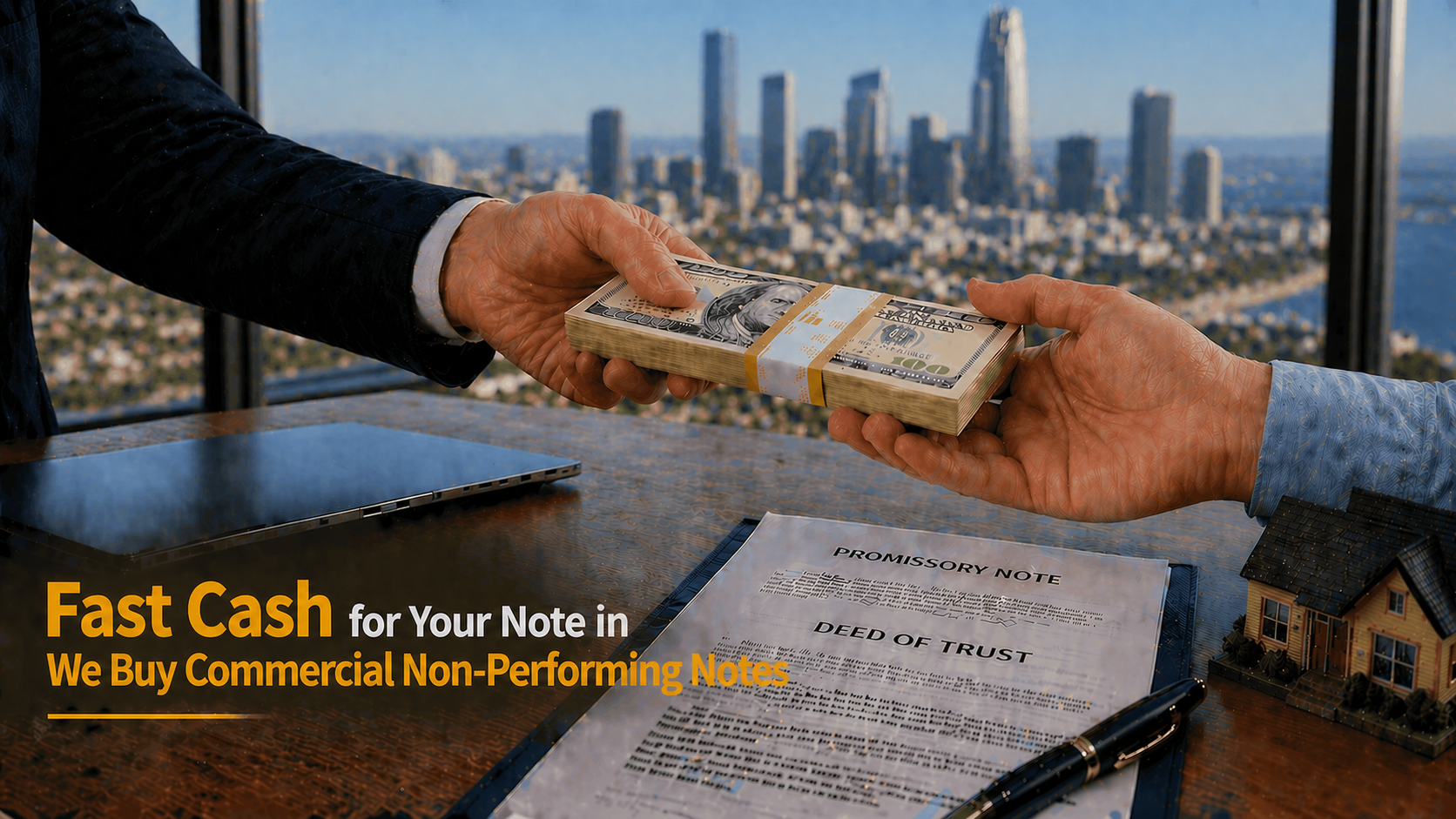
Your borrower stopped paying on a commercial property. The note is non-performing. And the situation is more complex than a standard residential default.
Commercial non-performing notes come with their own set of challenges. The collateral is harder to value. The resolution process is more complex. And the legal costs of pursuing foreclosure on a commercial property can be substantial.
TrustedNoteBuyer.com buys commercial non-performing notes across all 50 states. We buy office buildings, retail centers, industrial facilities, mixed-use properties, and more. We buy single notes and entire portfolios. And we pay cash — fast, fairly, and with zero fees.
You do not have to fund a complex commercial foreclosure. You do not have to manage a delinquent commercial borrower. And you do not have to carry the risk and expense of a commercial default that is costing you more every month.
You can sell now. Get your cash. Move on.
What is a commercial non-performing note?
A commercial non-performing note is a mortgage note, deed of trust, or land contract secured by a commercial property where the borrower has stopped making payments. Most buyers define non-performing as 90 or more days past due. However, it also includes notes where the borrower has received a formal notice of default or where foreclosure proceedings have already started.
Commercial non-performing notes differ from residential ones in several important ways. The collateral is more complex to value. The resolution process involves more specialized legal expertise. And the buyer pool for commercial properties after foreclosure is narrower than for residential ones.
Furthermore, commercial borrowers often have more sophisticated legal resources than residential borrowers. They are more likely to contest foreclosure, file for bankruptcy, or negotiate aggressively. Therefore, resolving a commercial default requires specialized expertise that most private note holders do not have.
Your commercial non-performing note still has real value
Many note holders assume that a non-performing commercial note has lost most of its value. That assumption is often wrong.
The value of a commercial non-performing note depends primarily on the real property securing it — and commercial properties can carry significant value even when the borrower has stopped paying. A well-located office building, a retail center with strong tenants, or an industrial facility in a growing market can all serve as strong collateral — even when the note is in default.
Furthermore, professional note buyers who specialize in commercial assets have the expertise and legal infrastructure to resolve commercial defaults efficiently. They know how to evaluate commercial collateral, navigate complex foreclosure proceedings, and maximize recovery from commercial properties.
Therefore, a commercial non-performing note is a complex asset — but it retains real value. And TrustedNoteBuyer.com has the expertise to evaluate it accurately and pay you a fair price.
Types of commercial non-performing notes we buy
TrustedNoteBuyer.com purchases a wide range of commercial non-performing notes. Your property type does not prevent a sale.
Office building notes
We purchase non-performing notes secured by office buildings — from small professional office suites to multi-story commercial office complexes. Office notes are evaluated based on property value, location, current occupancy, and the cost and timeline of resolution in the state.
Retail property notes
We buy non-performing notes secured by retail properties — strip centers, standalone retail buildings, shopping centers, and mixed retail complexes. Retail property notes require evaluation of both the property value and the tenant situation. Occupied retail properties with paying tenants are more valuable collateral than vacant ones.
Industrial and warehouse notes
We purchase non-performing notes secured by industrial facilities, warehouses, distribution centers, and manufacturing properties. Industrial properties are often simpler to evaluate than other commercial types — they tend to have clear market comparables and a straightforward buyer pool. Therefore, strong LTV industrial notes can receive competitive offers.
Mixed-use property notes
We buy non-performing notes secured by mixed-use properties — buildings that combine residential and commercial uses. Mixed-use notes require evaluation of both the residential and commercial components. However, when the overall LTV is strong, mixed-use notes are purchased regularly.
Multi-family apartment notes
We purchase non-performing notes secured by apartment complexes and larger multi-family properties — typically five or more units. These properties are classified as commercial for lending purposes. They are evaluated based on both property value and income potential. Occupied properties with paying tenants receive stronger offers than vacant ones.
Hotel and hospitality notes
We buy non-performing notes secured by hotels, motels, and other hospitality properties in certain situations. Hospitality notes are among the most complex commercial note types — they are operationally intensive and highly sensitive to market conditions. Therefore, offers on hospitality notes are more conservative and reflect the additional complexity involved.
Land notes
We purchase non-performing notes secured by commercial land — entitled land, development-ready parcels, and raw land in growing markets. Land notes are more challenging than improved property notes because the collateral generates no income and is harder to sell quickly. However, strong LTV land notes — particularly in active development markets — are purchased regularly.
Why commercial non-performing notes are more complex
Understanding what makes commercial defaults more complex helps you know what to expect — and why working with a specialized buyer matters.
Complex collateral valuation
Residential properties are valued primarily by comparable sales. Commercial properties require income-based valuation approaches — capitalization rates, net operating income analysis, and market rent comparisons — in addition to comparable sales data. Furthermore, commercial property values are more sensitive to market conditions and location dynamics than residential values.
Specialized legal expertise required
Commercial foreclosure proceedings are more complex than residential ones. Commercial borrowers are more likely to have sophisticated legal representation. They may contest the foreclosure, assert defenses, file for Chapter 11 bankruptcy, or negotiate aggressively throughout the process. Resolving a commercial default requires specialized legal expertise — and specialized buyers who work with commercial foreclosure attorneys every day.
Longer resolution timelines
Commercial foreclosures generally take longer than residential ones — even in fast non-judicial states. The complexity of commercial borrower situations, the sophistication of their legal teams, and the additional procedural requirements of commercial proceedings all extend the timeline. Therefore, commercial non-performing notes typically receive deeper discounts than residential ones to account for the longer resolution period.
Narrower buyer pool for the underlying asset
After a commercial property goes through foreclosure, the pool of potential buyers is narrower than for residential properties. Commercial buyers are more specialized, more selective, and more sensitive to market conditions. A vacant office building in a weak market may take significantly longer to sell than a single-family home in the same city. Buyers factor that liquidity risk into their offer.
How we price commercial non-performing notes
Our evaluation process for commercial non-performing notes is thorough, logical, and transparent. Here is exactly what we look at.
Loan-to-value ratio
The LTV remains the most important pricing factor — even for commercial notes. We compare the outstanding loan balance to the current market value of the property. A low LTV means strong collateral protection and a stronger offer. A high LTV means thin equity and a deeper discount.
For commercial properties, the current market value is determined through an income approach — based on current or potential net operating income — as well as a sales comparison approach where comparable transactions are available.
Property type and condition
Different commercial property types carry different risk profiles. Industrial properties and multi-family buildings tend to receive stronger offers because they are easier to value and have more liquid markets. Office and retail properties vary significantly depending on location, occupancy, and market conditions. Hospitality and land notes require more conservative pricing due to their operational complexity and liquidity limitations.
Property condition matters significantly for commercial assets. A well-maintained building with functional systems and an acceptable physical condition supports a stronger offer. A property with deferred maintenance, environmental concerns, or significant physical deterioration requires additional pricing conservatism.
Occupancy and income status
For income-producing commercial properties, the current occupancy and rental income status directly affects the offer. A fully occupied retail center with long-term leases is more valuable collateral than a vacant one. An apartment complex with paying tenants generates income that offsets carrying costs during resolution. Therefore, provide current occupancy and income information when you submit your commercial note for evaluation.
State foreclosure timeline
Every state handles commercial foreclosure differently — and the timelines are generally longer than for residential foreclosure. Slow judicial foreclosure states add years of legal costs and timeline risk. Fast non-judicial states allow faster resolutions. This factor is particularly impactful for commercial notes because the legal costs of a commercial foreclosure are higher to begin with.
Borrower sophistication and legal status
Is the borrower in bankruptcy? Have they filed a lis pendens contesting the debt? Do they have a history of aggressively contesting legal proceedings? These factors affect how difficult and costly the resolution process will be — and they are reflected in the offer.
Documentation completeness
Complete, well-organized documentation is particularly important for commercial note transactions. The original promissory note, the deed of trust or mortgage, a full payment history, recorded default notices, environmental reports, current rent rolls, and property financial statements all contribute to a faster, more accurate evaluation.
How to sell your commercial non-performing note — step by step
Step 1 — Gather your documents and property information
Before reaching out, organize your core documents. Gather the original promissory note, the deed of trust or mortgage, a complete payment history, any recorded notices of default or foreclosure filings, and detailed property information.
For commercial notes, property information goes beyond the basic address and property type. Include current rent rolls showing all tenants, lease terms, and payment status. Include recent income and expense statements if available. Include any environmental reports or property condition assessments you have. And include a current appraisal or broker price opinion if one is available.
The more complete your commercial property information, the faster and more accurately we can evaluate your note.
Step 2 — Contact TrustedNoteBuyer.com
Reach out through our online form or speak directly with our team. Share the property address, unpaid principal balance, original loan terms, current default status, and property type. Be transparent about every aspect of the commercial situation — the delinquency history, the occupancy status, any legal proceedings, and any environmental or physical concerns.
Transparency upfront produces the most accurate offer and prevents delays during due diligence.
Step 3 — Receive your written cash offer
After reviewing your note and evaluating the commercial collateral, we present a written cash offer. For commercial notes, the evaluation process may take a few additional days compared to residential notes — because the collateral analysis is more complex. However, most sellers receive their offer within three to five business days of submitting complete documentation.
We explain every offer clearly. We walk you through the LTV, the property type, the state, the occupancy status, and every other factor that drove the number. There is no obligation to accept. There are no fees at any stage.
Step 4 — Accept and complete due diligence
Once you accept, due diligence begins immediately. For commercial notes, due diligence is more thorough than for residential transactions. We review your documents in detail — confirming the loan terms, verifying the collateral value through a commercial appraisal or income analysis, checking the lien position, reviewing the tenant situation, and identifying any environmental or title issues.
Commercial due diligence typically takes two to three weeks with complete documentation. Respond promptly to every request. The faster you respond, the faster you close.
Step 5 — Close and receive your funds
Closing is handled through a licensed title company or escrow agent. You sign the transfer documents. We fund the transaction. Your cash is wired directly to your bank account on closing day.
After closing, the note is ours. We take over the borrower relationship, all legal proceedings, tenant management responsibilities, and the ultimate resolution of the commercial default. You walk away with cash and zero further obligations.
The entire process — from initial submission to funded closing — typically takes three to six weeks for commercial note transactions.
We buy commercial non-performing note portfolios
Holding multiple commercial non-performing notes? Or a mixed portfolio of residential and commercial notes — performing and non-performing?
You can sell everything in a single transaction.
TrustedNoteBuyer.com purchases commercial non-performing note portfolios of all sizes. We buy mixed portfolios containing residential, commercial, and land notes together in a single closing. We handle performing and non-performing notes simultaneously. And we work across all 50 states.
Portfolio sales close everything at once. You deal with one buyer through one process. And you free up all of your capital simultaneously.
Frequently asked questions
What types of commercial properties do you buy non-performing notes on?
We purchase non-performing notes secured by office buildings, retail centers, industrial facilities, warehouses, mixed-use properties, multi-family apartment complexes, hotels, and commercial land — across all 50 states.
How much will I receive for my commercial non-performing note?
Commercial non-performing notes typically sell at a deeper discount than residential notes — reflecting the additional complexity, longer resolution timelines, and narrower buyer pool. The exact offer depends on the LTV, the property type, the occupancy status, the state, and the documentation completeness. Submit your note for a free evaluation to get your specific number.
Can I sell a commercial non-performing note already in foreclosure?
Yes. We purchase commercial notes at every stage of the foreclosure process — including active judicial and non-judicial proceedings in any state.
Do you buy commercial notes where the borrower filed for Chapter 11 bankruptcy?
Yes. We purchase commercial non-performing notes in Chapter 11 bankruptcy situations. These are among the most complex commercial note transactions — and our team has the specialized expertise to evaluate and close on them.
How long does it take to sell a commercial non-performing note?
Commercial note transactions typically take three to six weeks from initial submission to funded closing — slightly longer than residential transactions due to the additional complexity of the commercial collateral evaluation.
Does TrustedNoteBuyer.com buy commercial non-performing notes in all 50 states?
Yes. We purchase commercial non-performing notes across all 50 states — single notes and portfolios, all commercial property types, all stages of default.
The bottom line
TrustedNoteBuyer.com buys commercial non-performing notes across all 50 states. All commercial property types. All stages of default. Single notes and portfolios of any size.
No fees. No brokers. No obligation. Fast offers and faster closings.
Ready to sell your commercial non-performing note? Get your free offer at TrustedNoteBuyer.com today.
We purchase defaulted notes and offer solutions for assets that are no longer producing income. Default often leads to legal complications and delays. Selling provides a faster and more reliable way to recover value.
Selling your non performing note for cash allows you to eliminate risk and access liquidity immediately. Instead of managing a troubled asset, you receive a lump sum payment. This provides certainty and financial flexibility.
We buy notes in default and specialize in acquiring high-risk, distressed assets. Defaulted notes often involve foreclosure timelines and legal challenges. Selling to a direct buyer provides a clean and efficient exit strategy.