The Complete Real Estate Note Seller’s Guide
If you’re holding a real estate note and the borrower has stopped making payments, you’re likely dealing with stress, uncertainty, and a growing sense that this asset is costing you more than it’s giving back. The good news is that there is a market for non-performing real estate notes — and you don’t have to wait years for the situation to resolve itself. You can sell.
This guide covers everything you need to know: what a non-performing note is, why buyers will purchase it, how much you can realistically expect to receive, and how the sale process works from start to close. Whether you’re holding a single loan or a portfolio of notes, this is your complete roadmap.
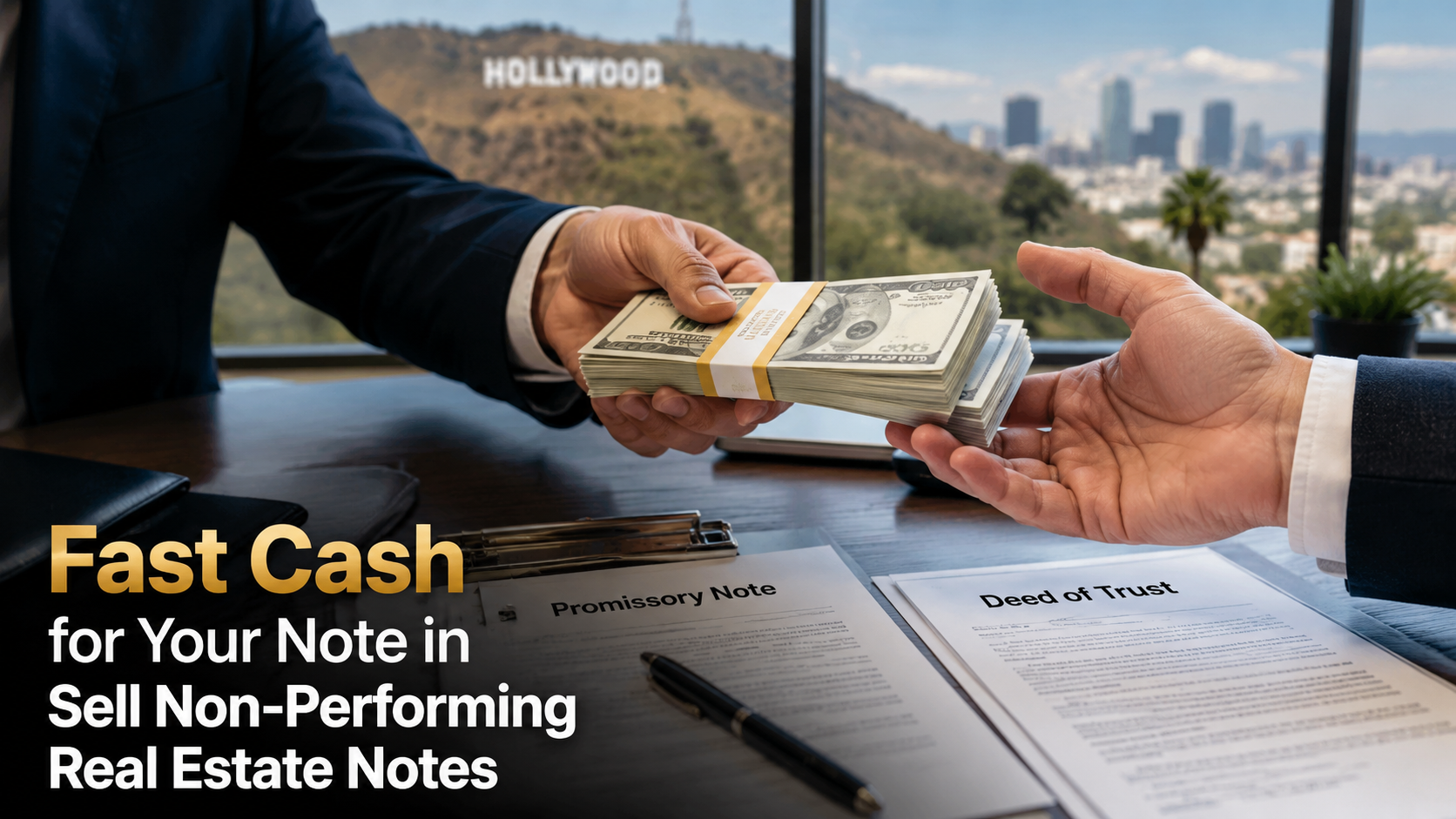
Stop dealing with missed payments—sell non performing real estate notes and convert your asset into immediate cash.
What Is a Non-Performing Real Estate Note?
A real estate note — sometimes called a mortgage note, promissory note, or deed of trust note — is the legal document a borrower signs promising to repay a real estate loan. When someone purchases a note, they step into the lender’s position and are entitled to receive those monthly payments.
A note becomes “non-performing” when the borrower stops making payments. The industry standard definition is a loan that is 90 or more days past due, though some note buyers classify loans as non-performing at 60 days delinquent. In plain terms: the borrower has defaulted, and the payments you were counting on are no longer coming in.
Non-performing notes can include:
- Residential mortgage notes (single-family homes, condos, townhomes)
- Commercial real estate notes (office, retail, industrial, mixed-use)
- Land notes and lot loans
- Seller-financed notes where the borrower has stopped paying
- Second position or junior lien notes in default
Why Would Anyone Buy a Non-Performing Note?
This is the first question most note holders ask — and it’s a fair one. If the borrower isn’t paying, why would any investor want to take this off your hands?
The answer is that experienced note investors have multiple strategies to profit from non-performing loans. When a buyer purchases your non-performing note at a discount, they may:
- Work with the borrower to reinstate the loan or modify the terms, turning it back into a performing, income-producing asset
- Negotiate a discounted payoff — the borrower pays a lump sum to settle the debt at less than the full balance
- Initiate foreclosure and take ownership of the underlying property, which they then sell or rent
- Sell the note again to another investor at a markup once they have improved its status
Experienced investors see non-performing notes as opportunities precisely because they can be purchased at deep discounts. That discount is where their profit potential lives — and it is also the reason you can sell your note today, even if the borrower has not paid in months.
| Key Point for Sellers The secondary market for non-performing real estate notes is active and well-established. Private investors, note buying companies, family offices, and investment funds all compete to acquire these assets. You are not stuck holding a loan that no longer works for you. |
How Much Will You Get for a Non-Performing Note?
Setting realistic expectations is critical before you enter the market. Non-performing notes sell at a discount to the unpaid principal balance (UPB) — sometimes a significant one. Understanding why this happens will help you evaluate any offer you receive.
Why Non-Performing Notes Sell at a Discount
When a buyer acquires your non-performing note, they are taking on the full risk and cost of resolution. That may mean months of legal fees to foreclose, the cost of managing or rehabilitating a property, negotiating with an uncooperative borrower, or waiting years for a workout. Buyers price that risk into the purchase offer.
Non-performing notes commonly sell at discounts of 30% to 60% or more off the unpaid principal balance, depending on the specific circumstances of the loan. A note with a $200,000 remaining balance might realistically sell for $80,000 to $140,000.
What Affects the Price of Your Note
Not all non-performing notes are valued the same. The following factors will directly influence what buyers are willing to pay:
- Property value and equity: The higher the property’s value relative to the loan balance, the more security a buyer has. A note with a low loan-to-value ratio commands a stronger offer.
- Property type and condition: A well-maintained residential property in a desirable market is more attractive to buyers than a vacant commercial building in a declining area.
- Loan position: First position (senior lien) notes are more valuable than second or third position notes. If you hold a junior lien, buyers face the risk of a senior lender foreclosing and wiping out their interest entirely.
- How long the note has been non-performing: A note that went delinquent 90 days ago is more valuable than one that has been non-performing for three years with extensive legal complications.
- State foreclosure timeline: Some states allow non-judicial foreclosure that can be completed in 60–90 days. Others require judicial foreclosure that can take two to four years. Buyers price this risk into their offers.
- Borrower situation: If the borrower still occupies the property and has some capacity to pay, a buyer sees more options for workout. A borrower who has abandoned the property and cannot be located is a more complex situation.
- Quality of the loan documents: Clean, properly executed and recorded documentation makes a note far easier to transfer and enforce. Gaps or errors in the paperwork reduce value.
| Example Pricing Scenario A first position residential note with a $150,000 unpaid balance, secured by a property worth $200,000, 90 days delinquent, in a non-judicial foreclosure state with a cooperative borrower — this note might attract offers of $90,000 to $120,000. The same note with a 3-year delinquency history in a judicial foreclosure state with an unlocatable borrower might receive offers of $40,000 to $65,000. |
Selling a Single Note vs. a Portfolio of Notes
Whether you hold one non-performing loan or a large book of loans, the market can accommodate you — but the process and pricing dynamics differ.
Selling a Single Non-Performing Note
Individual note holders — private lenders, seller-finance note holders, or individuals who inherited a loan — typically sell one note at a time. The process is straightforward: you submit your note details to a buyer, they conduct due diligence, and you receive an offer. Single note transactions typically close in 15 to 45 days.
The key is working with a direct buyer rather than a broker chain. When multiple middlemen are involved, each one takes a margin that reduces your net proceeds. A direct buyer like Trusted Note Buyer evaluates your note and makes an offer with no intermediaries reducing your payout.
Selling a Portfolio of Non-Performing Notes
If you hold multiple non-performing loans — whether you’re a private lender, a community bank, a credit union, or an investment fund looking to clean up a book of distressed assets — selling as a portfolio (often called a “loan tape” or “note pool”) has distinct advantages:
- Efficiency: One transaction clears multiple problem assets simultaneously, freeing up your time, attention, and balance sheet all at once.
- Speed: Portfolio buyers are set up to handle bulk acquisitions. Due diligence processes are streamlined when a buyer reviews multiple loans in a single data room.
- Certainty: Portfolio sales often attract institutional buyers with committed capital, reducing the risk of a deal falling through.
- Pricing: While individual notes with strong collateral may receive better pricing when sold separately, a portfolio sale eliminates the effort of marketing and managing multiple individual transactions.
For portfolio sellers, preparation is everything. Buyers will request a loan tape — a spreadsheet containing the key data for each loan, including unpaid principal balance, property address, loan position, last payment date, and borrower status. Having this organized and ready shortens the timeline and improves your negotiating position.
The Step-by-Step Process to Sell a Non-Performing Note
Selling a non-performing real estate note is simpler than most people expect. Here is how the process works from initial contact to cash in hand.
- Gather your documentation. Before contacting any buyer, pull together the original promissory note, the mortgage or deed of trust, the payment history (or lack thereof), the current property address, the estimated property value, and the unpaid principal balance. Having these ready speeds everything up.
- Submit your note details. Contact a direct note buyer and provide the basic information about your loan. Most buyers, including Trusted Note Buyer, have an online submission form that takes minutes to complete. For portfolios, you’ll submit your loan tape.
- Receive a preliminary offer. Within a few business days, a qualified buyer will present a preliminary offer. This is based on the information you provided and is subject to due diligence.
- Due diligence period. The buyer will order a property valuation, review the loan documents, verify the title, and assess the borrower situation. This phase typically takes 1–3 weeks for a single note and 2–4 weeks for a portfolio.
- Final offer and acceptance. Once due diligence is complete, the buyer presents a final offer. You can accept, decline, or negotiate. There is no obligation at any stage.
- Closing. Once you accept, a title company or closing attorney handles the transfer of the note. The assignment is recorded, and you receive your funds — typically via wire transfer. From acceptance to closing usually takes 5–15 business days.
| What to Expect on Timeline A well-documented single non-performing note can close in as little as 15 business days from first contact. A larger portfolio typically runs 30–60 days from submission to close, depending on the complexity of the assets and the speed of third-party service providers like title companies and appraisers. |
Documents You Need to Sell Your Non-Performing Note
Being organized with your paperwork is one of the most effective ways to speed up the sale and protect your proceeds. Buyers who receive complete documentation move faster and price more aggressively than those who have to chase down missing information. Here is what you need to have ready:
- Original promissory note (the signed IOU from the borrower)
- Mortgage, deed of trust, or land contract (the security instrument recorded against the property)
- Complete payment history showing all payments made and the date of last payment
- Loan modification agreements, forbearance agreements, or any amendments to the original loan terms
- Current unpaid principal balance statement
- Property address and county of recording
- Any correspondence with the borrower regarding the delinquency
- Title insurance policy (if available from original closing)
- Any pending or completed foreclosure filings
For portfolio sellers, all of the above is typically organized into a loan tape spreadsheet, with one row per loan and columns for each data point. We can provide you with a standard loan tape template to make this process straightforward.
Common Questions Sellers Ask
Is there really a buyer for my note if the borrower hasn’t paid in years?
Yes. The age of the delinquency affects price, but it does not eliminate the market. Buyers acquire notes at all stages of non-performance, including loans in active foreclosure and loans with borrowers who are completely unresponsive. The deeper the delinquency, the steeper the discount — but the market exists.
Do I need to have already started foreclosure?
No. You can sell at any point in the delinquency, before, during, or even after foreclosure proceedings have begun. If foreclosure is already in progress, that information is part of the due diligence and will factor into the offer — but it does not disqualify your note from sale.
What if my loan documents are not perfect?
Imperfect documentation is common and does not automatically prevent a sale. Gaps in the chain of title, missing endorsements, or servicing irregularities will affect how buyers value the note, but experienced buyers know how to work with imperfect paper. Disclose everything you know — transparency protects you and keeps transactions from falling apart late in the process.
Can I sell just part of my note?
In some cases, yes. A partial note purchase allows you to sell a portion of the remaining payments in exchange for a lump sum today, while retaining rights to the balance of the payments once the sold portion is satisfied. This can be useful if you want to access cash without selling the entire note. Not all buyers offer partials on non-performing notes, but it is worth asking.
What are the tax implications?
The tax treatment of a note sale depends on how you originally acquired the note, whether it was held as a capital asset or as ordinary income, and your basis in the note. In most cases the proceeds are treated as a capital gain or loss. You should consult a tax professional or CPA before completing any note sale — this post is informational only and is not tax advice.
Why Sellers Choose to Sell Now Rather Than Wait
Many note holders initially resist selling because they believe the situation will eventually resolve itself — the borrower will start paying again, the foreclosure will complete and they’ll get the property, or the market will improve. Some of those outcomes are possible. But there are real costs to waiting that are easy to underestimate.
- Monthly servicing costs continue whether or not the borrower pays. Loan servicers charge fees to track the account, send notices, and comply with regulatory requirements.
- Legal costs for foreclosure can run tens of thousands of dollars in judicial foreclosure states, and the process can take years.
- The time value of money is real. A dollar today is worth more than a dollar received four years from now after a lengthy foreclosure process.
- Property condition can deteriorate while you wait. A vacant or abandoned property depreciates and may require significant investment before it can be sold or rented.
- Borrower situations often get more complicated over time, not less — bankruptcy filings, additional liens, and legal disputes can all erode the value of your note further.
For most holders of non-performing notes, the decision to sell comes down to this: is the certainty of a lump sum today more valuable than the uncertain and potentially costly process of waiting for a resolution? For a great many sellers, the answer is yes.
| Ready to Find Out What Your Note Is Worth? Trusted Note Buyer purchases non-performing real estate notes nationwide — single loans and portfolios. The process is simple, there is no obligation, and we close fast. Submit your note details today and receive a no-obligation cash offer within 48 hours. |
Next Steps
Selling a non-performing real estate note does not have to be complicated or stressful. The market is active, experienced buyers are ready to move quickly, and you can turn a problem asset into cash faster than most people expect.
Here is what to do right now:
- Gather your basic note information: unpaid balance, property address, and last payment date.
- Submit your note details using our simple online form — it takes less than five minutes.
- Receive a no-obligation cash offer within 48 hours.
- If the offer works for you, we handle the rest through a smooth, professional closing process.
Whether you hold one loan or a hundred, Trusted Note Buyer is ready to work with you. Contact us today to get started.
Stop dealing with missed payments—sell non performing real estate notes and convert your asset into immediate cash.